

Minimalism and maximalism in biotechnology
Biology doesn’t have to sacrifice beauty for scale, neither should biotechnology.

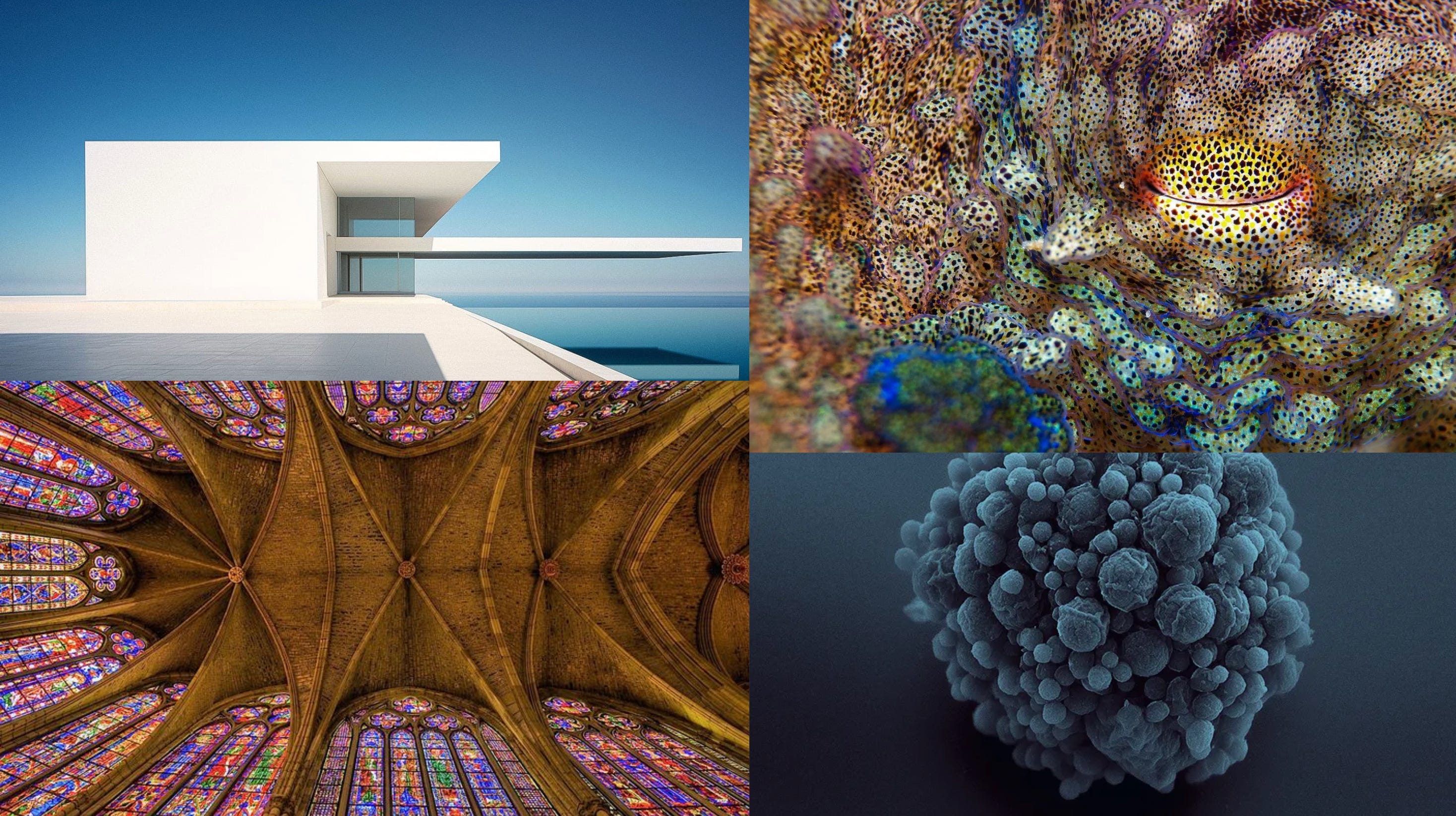
In the last couple of years I’ve seen a lot of criticism1 toward minimalism. People will compare a modern building to a Gothic cathedral and go “when did we stop building beautiful things? Modern design prioritizes convenience, and it is making us sick with its neutral colors, smooth surfaces, narrow constraints, and lack of stories”.
When looking at bioreactors, minimal cells, recombinant proteins, and IVF robots, I cannot help but wonder whether biotechnology is following a similar minimalist ideology by stripping the complexity from wild-type biology.
Broadly speaking, definitions in art and design will say that minimalism is the emphasis on the essence of something and that it avoids expressing the opinion of its creator or any other non-essential wrapping, because “less is more”. Conversely, maximalism could be thought of as the excess and abundance of something, because “more is more”.
But according to whom or to what standards are we making these claims? Is biology minimalist because evolution selects for the survival and reproduction of functional elements by spelling only four letters differently? Or is it maximalist because of the “immense” diversity and symbiotic relationships that emerge from this code, spanning the cell to a world?
After WWII, minimalism arose both due to the need to rebuild cities fast, and as a philosophical statement against the historical maximalism practiced by the elites. Ironically, in simplifying objects, minimalism incentivizes their mass usage and consumption. This is better exemplified by minimalist yet addictive social media interfaces, and is also present in home decoration with programmed obsolescence that results in consumerism and houses that can be built in days and scaled to neighborhoods that look the same.


Minimalism and maximalism, however, are not opposite but intertwining and, in fact, complementary ideologies. A synthetic cell grown in a bioreactor for a single function can seem as minimalist as an iPhone made out of stainless steel and glass running 0s and 1s. But both hold immense power to scale in complexity and thus generate a maximalist amount of AI slop or a biological catalog the size of planet Earth.
Instead of absolute maximalism or minimalism, biology pursues homeostasis. Simple at the impermanent individual level, complex at the enduring population level. Neither waste nor excessive consumption can be afforded. Convenience is required, but details are essential. Biology doesn’t have to sacrifice beauty for scale.
Keep reading with a 7-day free trial
Subscribe to Biopunk to keep reading this post and get 7 days of free access to the full post archives.